human pad2 protein Search Results


ln-18  (ATCC)
96
ATCC ln-18
Ln 18, supplied by ATCC, used in various techniques. Bioz Stars score: 96/100, based on 1 PubMed citations. ZERO BIAS - scores, article reviews, protocol conditions and more
https://www.bioz.com/result/ln-18/product/ATCC
Average 96 stars, based on 1 article reviews
ln-18 - by Bioz Stars, 2026-04
96/100 stars
  Buy from Supplier

90
Novus Biologicals pad2
Pad2, supplied by Novus Biologicals, used in various techniques. Bioz Stars score: 90/100, based on 1 PubMed citations. ZERO BIAS - scores, article reviews, protocol conditions and more
https://www.bioz.com/result/pad2/product/Novus Biologicals
Average 90 stars, based on 1 article reviews
pad2 - by Bioz Stars, 2026-04
90/100 stars
  Buy from Supplier

90
ModiQuest recombinant human pad2
Human MDMs (A) and mouse RAW 264.7 (B) macrophages were stimulated with 10 ng/mL LPS in the presence of native or citrullinated LL-37 at the indicated concentrations (0.1–10 μg/mL). Citrullinated LL-37 was obtained by treatment of the native peptide with human <t>PAD2</t> or PAD4 at 23.3 U/mg peptide). The level of TNF-α (A) and NO (B) in the culture supernatants was determined using ELISA or the Griess assay at 6 or 20 h post-stimulation, respectively. Since neither the LL-37 nor the PAD enzymes alone induced the release of NO or TNF-α, for the sake of clarity these controls are not shown in the figure. Data represent the mean ± SD of three independent experiments. ns, not significant; *, p<0.05; **, p<0.01; ***, p<0.001.
Recombinant Human Pad2, supplied by ModiQuest, used in various techniques. Bioz Stars score: 90/100, based on 1 PubMed citations. ZERO BIAS - scores, article reviews, protocol conditions and more
https://www.bioz.com/result/recombinant human pad2/product/ModiQuest
Average 90 stars, based on 1 article reviews
recombinant human pad2 - by Bioz Stars, 2026-04
90/100 stars
  Buy from Supplier

94
Proteintech anti padi2
Human MDMs (A) and mouse RAW 264.7 (B) macrophages were stimulated with 10 ng/mL LPS in the presence of native or citrullinated LL-37 at the indicated concentrations (0.1–10 μg/mL). Citrullinated LL-37 was obtained by treatment of the native peptide with human <t>PAD2</t> or PAD4 at 23.3 U/mg peptide). The level of TNF-α (A) and NO (B) in the culture supernatants was determined using ELISA or the Griess assay at 6 or 20 h post-stimulation, respectively. Since neither the LL-37 nor the PAD enzymes alone induced the release of NO or TNF-α, for the sake of clarity these controls are not shown in the figure. Data represent the mean ± SD of three independent experiments. ns, not significant; *, p<0.05; **, p<0.01; ***, p<0.001.
Anti Padi2, supplied by Proteintech, used in various techniques. Bioz Stars score: 94/100, based on 1 PubMed citations. ZERO BIAS - scores, article reviews, protocol conditions and more
https://www.bioz.com/result/anti padi2/product/Proteintech
Average 94 stars, based on 1 article reviews
anti padi2 - by Bioz Stars, 2026-04
94/100 stars
  Buy from Supplier

90
Cayman Chemical recombinant human pad2
Human MDMs (A) and mouse RAW 264.7 (B) macrophages were stimulated with 10 ng/mL LPS in the presence of native or citrullinated LL-37 at the indicated concentrations (0.1–10 μg/mL). Citrullinated LL-37 was obtained by treatment of the native peptide with human <t>PAD2</t> or PAD4 at 23.3 U/mg peptide). The level of TNF-α (A) and NO (B) in the culture supernatants was determined using ELISA or the Griess assay at 6 or 20 h post-stimulation, respectively. Since neither the LL-37 nor the PAD enzymes alone induced the release of NO or TNF-α, for the sake of clarity these controls are not shown in the figure. Data represent the mean ± SD of three independent experiments. ns, not significant; *, p<0.05; **, p<0.01; ***, p<0.001.
Recombinant Human Pad2, supplied by Cayman Chemical, used in various techniques. Bioz Stars score: 90/100, based on 1 PubMed citations. ZERO BIAS - scores, article reviews, protocol conditions and more
https://www.bioz.com/result/recombinant human pad2/product/Cayman Chemical
Average 90 stars, based on 1 article reviews
recombinant human pad2 - by Bioz Stars, 2026-04
90/100 stars
  Buy from Supplier

95
Proteintech pad2
a, The enzymatic reaction mediated by PADs converts arginine to citrulline. b, c, Western blot images of <t>PAD2</t> and PAD4-mediated citrullination of H3 (b) and TDP-43 (c). In (c) arrows indicate the observed shift in TDP-43 molecular weight. d, Coomassie staining of PAD2 (bands 1, 4), PAD4 (bands 2, 6), unmodified TDP-43 (band 3), PAD2-mediated citR TDP-43 (band 5), and PAD4-mediated citR TDP-43 (band 7). e, Bar diagrams showing the MW shift (kDa) of TDP-43 protein following citrullination. f, Schematic representation of arginine epitopes positioned in the human TDP-43 protein sequence. Position of the 11 citrullinated arginine epitopes are indicated in red. g, Six out of eleven arginine epitopes susceptible to citrullination laid within common RX(X)R (red box) or RXG/RGGG (green box) motifs in TDP-43 sequence. h, MS/MS spectrum showing b- and y-ion coverage of modified citR83 peptide and extracted ion chromatograms (XICs) showed abundance and retention time of unmodified R83 vs. citR83 with PAD2 and PAD4 treatment (intact peptide monoisotopic m/z (+2) 719.8457, (+3) 480.2329). i, Retention time peaks for TDP-43 peptides surrounding the unmodified or modified R83 epitope and base peak m/z undergoing methionine (Met85) oxidation, citrullination or both showed reliable time separation.
Pad2, supplied by Proteintech, used in various techniques. Bioz Stars score: 95/100, based on 1 PubMed citations. ZERO BIAS - scores, article reviews, protocol conditions and more
https://www.bioz.com/result/pad2/product/Proteintech
Average 95 stars, based on 1 article reviews
pad2 - by Bioz Stars, 2026-04
95/100 stars
  Buy from Supplier

94
Proteintech anti pad2
a, The enzymatic reaction mediated by PADs converts arginine to citrulline. b, c, Western blot images of <t>PAD2</t> and PAD4-mediated citrullination of H3 (b) and TDP-43 (c). In (c) arrows indicate the observed shift in TDP-43 molecular weight. d, Coomassie staining of PAD2 (bands 1, 4), PAD4 (bands 2, 6), unmodified TDP-43 (band 3), PAD2-mediated citR TDP-43 (band 5), and PAD4-mediated citR TDP-43 (band 7). e, Bar diagrams showing the MW shift (kDa) of TDP-43 protein following citrullination. f, Schematic representation of arginine epitopes positioned in the human TDP-43 protein sequence. Position of the 11 citrullinated arginine epitopes are indicated in red. g, Six out of eleven arginine epitopes susceptible to citrullination laid within common RX(X)R (red box) or RXG/RGGG (green box) motifs in TDP-43 sequence. h, MS/MS spectrum showing b- and y-ion coverage of modified citR83 peptide and extracted ion chromatograms (XICs) showed abundance and retention time of unmodified R83 vs. citR83 with PAD2 and PAD4 treatment (intact peptide monoisotopic m/z (+2) 719.8457, (+3) 480.2329). i, Retention time peaks for TDP-43 peptides surrounding the unmodified or modified R83 epitope and base peak m/z undergoing methionine (Met85) oxidation, citrullination or both showed reliable time separation.
Anti Pad2, supplied by Proteintech, used in various techniques. Bioz Stars score: 94/100, based on 1 PubMed citations. ZERO BIAS - scores, article reviews, protocol conditions and more
https://www.bioz.com/result/anti pad2/product/Proteintech
Average 94 stars, based on 1 article reviews
anti pad2 - by Bioz Stars, 2026-04
94/100 stars
  Buy from Supplier

90
ProteoGenix murine pad2 pad4
IgG responses to PADs in C3H mice. IgG responses to murine <t>PAD2</t> or human PAD2 or human PAD4 were analyzed by ELISAs. Plates were coated with PADs and blocked with BSA. Sera from primed mice were obtained at 15, 35, 55, and 65 d postimmunization and were diluted at 1/40. ( A ) For PBS-immunized mice, 15 sera were tested for murine PAD2, 8 sera were tested for human PAD2, and 9 sera were tested for human PAD4. ( B ) For PAD-immunized mice, each serum was tested against the same PAD used for each immunization. After washing, peroxidase-conjugated antimurine IgG was added. The OD was read at 405 nm. The background OD was obtained by adding each serum to a well without PAD (negative). Positive sera were defined as an OD value higher than twice the background OD.
Murine Pad2 Pad4, supplied by ProteoGenix, used in various techniques. Bioz Stars score: 90/100, based on 1 PubMed citations. ZERO BIAS - scores, article reviews, protocol conditions and more
https://www.bioz.com/result/murine pad2 pad4/product/ProteoGenix
Average 90 stars, based on 1 article reviews
murine pad2 pad4 - by Bioz Stars, 2026-04
90/100 stars
  Buy from Supplier

90
Millipore rabbit skeletal peptidylarginine deiminase-2 (pad2
IgG responses to PADs in C3H mice. IgG responses to murine <t>PAD2</t> or human PAD2 or human PAD4 were analyzed by ELISAs. Plates were coated with PADs and blocked with BSA. Sera from primed mice were obtained at 15, 35, 55, and 65 d postimmunization and were diluted at 1/40. ( A ) For PBS-immunized mice, 15 sera were tested for murine PAD2, 8 sera were tested for human PAD2, and 9 sera were tested for human PAD4. ( B ) For PAD-immunized mice, each serum was tested against the same PAD used for each immunization. After washing, peroxidase-conjugated antimurine IgG was added. The OD was read at 405 nm. The background OD was obtained by adding each serum to a well without PAD (negative). Positive sera were defined as an OD value higher than twice the background OD.
Rabbit Skeletal Peptidylarginine Deiminase 2 (Pad2, supplied by Millipore, used in various techniques. Bioz Stars score: 90/100, based on 1 PubMed citations. ZERO BIAS - scores, article reviews, protocol conditions and more
https://www.bioz.com/result/rabbit skeletal peptidylarginine deiminase-2 (pad2/product/Millipore
Average 90 stars, based on 1 article reviews
rabbit skeletal peptidylarginine deiminase-2 (pad2 - by Bioz Stars, 2026-04
90/100 stars
  Buy from Supplier

90
Talecris Biotherapeutics human serum albumin hsa
IgG responses to PADs in C3H mice. IgG responses to murine <t>PAD2</t> or human PAD2 or human PAD4 were analyzed by ELISAs. Plates were coated with PADs and blocked with BSA. Sera from primed mice were obtained at 15, 35, 55, and 65 d postimmunization and were diluted at 1/40. ( A ) For PBS-immunized mice, 15 sera were tested for murine PAD2, 8 sera were tested for human PAD2, and 9 sera were tested for human PAD4. ( B ) For PAD-immunized mice, each serum was tested against the same PAD used for each immunization. After washing, peroxidase-conjugated antimurine IgG was added. The OD was read at 405 nm. The background OD was obtained by adding each serum to a well without PAD (negative). Positive sera were defined as an OD value higher than twice the background OD.
Human Serum Albumin Hsa, supplied by Talecris Biotherapeutics, used in various techniques. Bioz Stars score: 90/100, based on 1 PubMed citations. ZERO BIAS - scores, article reviews, protocol conditions and more
https://www.bioz.com/result/human serum albumin hsa/product/Talecris Biotherapeutics
Average 90 stars, based on 1 article reviews
human serum albumin hsa - by Bioz Stars, 2026-04
90/100 stars
  Buy from Supplier

90
Merck & Co f95 pan-deimination antibody
Deiminated proteins in hemolymph of blue mussel ( Mytilus edulis ), as identified by <t> F95-enrichment </t> in conjunction with LC–MS/MS analysis. Deiminated proteins were isolated from hemolymph (a pool of hemolymph from four individual animals) by immunoprecipitation using the <t> pan-deimination F95 antibody. </t> The resulting F95-enriched eluate was then analyzed by LC–MS/MS and peak list files submitted to Mascot, using both a species-specific as well as a common Mollusca database. Peptide sequence hits are listed, showing species-specific hits, number of sequences for protein hits, and total score. Species hit names are indicated, blue mussel specific hits are on the top of the list and highlighted. *Proteins only identified in blue mussel. (See <xref ref-type= Table S1 for full details on all protein hits)." width="250" height="auto" />
F95 Pan Deimination Antibody, supplied by Merck & Co, used in various techniques. Bioz Stars score: 90/100, based on 1 PubMed citations. ZERO BIAS - scores, article reviews, protocol conditions and more
https://www.bioz.com/result/f95 pan-deimination antibody/product/Merck & Co
Average 90 stars, based on 1 article reviews
f95 pan-deimination antibody - by Bioz Stars, 2026-04
90/100 stars
  Buy from Supplier

90
ModiQuest recombinant human pad4
Deiminated proteins in hemolymph of blue mussel ( Mytilus edulis ), as identified by <t> F95-enrichment </t> in conjunction with LC–MS/MS analysis. Deiminated proteins were isolated from hemolymph (a pool of hemolymph from four individual animals) by immunoprecipitation using the <t> pan-deimination F95 antibody. </t> The resulting F95-enriched eluate was then analyzed by LC–MS/MS and peak list files submitted to Mascot, using both a species-specific as well as a common Mollusca database. Peptide sequence hits are listed, showing species-specific hits, number of sequences for protein hits, and total score. Species hit names are indicated, blue mussel specific hits are on the top of the list and highlighted. *Proteins only identified in blue mussel. (See <xref ref-type= Table S1 for full details on all protein hits)." width="250" height="auto" />
Recombinant Human Pad4, supplied by ModiQuest, used in various techniques. Bioz Stars score: 90/100, based on 1 PubMed citations. ZERO BIAS - scores, article reviews, protocol conditions and more
https://www.bioz.com/result/recombinant human pad4/product/ModiQuest
Average 90 stars, based on 1 article reviews
recombinant human pad4 - by Bioz Stars, 2026-04
90/100 stars
  Buy from Supplier

Image Search Results


Human MDMs (A) and mouse RAW 264.7 (B) macrophages were stimulated with 10 ng/mL LPS in the presence of native or citrullinated LL-37 at the indicated concentrations (0.1–10 μg/mL). Citrullinated LL-37 was obtained by treatment of the native peptide with human PAD2 or PAD4 at 23.3 U/mg peptide). The level of TNF-α (A) and NO (B) in the culture supernatants was determined using ELISA or the Griess assay at 6 or 20 h post-stimulation, respectively. Since neither the LL-37 nor the PAD enzymes alone induced the release of NO or TNF-α, for the sake of clarity these controls are not shown in the figure. Data represent the mean ± SD of three independent experiments. ns, not significant; *, p<0.05; **, p<0.01; ***, p<0.001.

Journal: Journal of immunology (Baltimore, Md. : 1950)

Article Title: Citrullination alters immunomodulatory function of LL-37 essential for prevention of endotoxin-induced sepsis

doi: 10.4049/jimmunol.1303062

Figure Lengend Snippet: Human MDMs (A) and mouse RAW 264.7 (B) macrophages were stimulated with 10 ng/mL LPS in the presence of native or citrullinated LL-37 at the indicated concentrations (0.1–10 μg/mL). Citrullinated LL-37 was obtained by treatment of the native peptide with human PAD2 or PAD4 at 23.3 U/mg peptide). The level of TNF-α (A) and NO (B) in the culture supernatants was determined using ELISA or the Griess assay at 6 or 20 h post-stimulation, respectively. Since neither the LL-37 nor the PAD enzymes alone induced the release of NO or TNF-α, for the sake of clarity these controls are not shown in the figure. Data represent the mean ± SD of three independent experiments. ns, not significant; *, p<0.05; **, p<0.01; ***, p<0.001.

Article Snippet: Recombinant human PAD2 and PAD4 were obtained from Modiquest (The Netherlands).

Techniques: Enzyme-linked Immunosorbent Assay, Griess Assay

a, The enzymatic reaction mediated by PADs converts arginine to citrulline. b, c, Western blot images of PAD2 and PAD4-mediated citrullination of H3 (b) and TDP-43 (c). In (c) arrows indicate the observed shift in TDP-43 molecular weight. d, Coomassie staining of PAD2 (bands 1, 4), PAD4 (bands 2, 6), unmodified TDP-43 (band 3), PAD2-mediated citR TDP-43 (band 5), and PAD4-mediated citR TDP-43 (band 7). e, Bar diagrams showing the MW shift (kDa) of TDP-43 protein following citrullination. f, Schematic representation of arginine epitopes positioned in the human TDP-43 protein sequence. Position of the 11 citrullinated arginine epitopes are indicated in red. g, Six out of eleven arginine epitopes susceptible to citrullination laid within common RX(X)R (red box) or RXG/RGGG (green box) motifs in TDP-43 sequence. h, MS/MS spectrum showing b- and y-ion coverage of modified citR83 peptide and extracted ion chromatograms (XICs) showed abundance and retention time of unmodified R83 vs. citR83 with PAD2 and PAD4 treatment (intact peptide monoisotopic m/z (+2) 719.8457, (+3) 480.2329). i, Retention time peaks for TDP-43 peptides surrounding the unmodified or modified R83 epitope and base peak m/z undergoing methionine (Met85) oxidation, citrullination or both showed reliable time separation.

Journal: bioRxiv

Article Title: Citrullination of TDP-43 is a key post-translation modification associated with structural and functional changes and progressive pathology in TDP-43 mouse models and human proteinopathies

doi: 10.1101/2025.02.28.639952

Figure Lengend Snippet: a, The enzymatic reaction mediated by PADs converts arginine to citrulline. b, c, Western blot images of PAD2 and PAD4-mediated citrullination of H3 (b) and TDP-43 (c). In (c) arrows indicate the observed shift in TDP-43 molecular weight. d, Coomassie staining of PAD2 (bands 1, 4), PAD4 (bands 2, 6), unmodified TDP-43 (band 3), PAD2-mediated citR TDP-43 (band 5), and PAD4-mediated citR TDP-43 (band 7). e, Bar diagrams showing the MW shift (kDa) of TDP-43 protein following citrullination. f, Schematic representation of arginine epitopes positioned in the human TDP-43 protein sequence. Position of the 11 citrullinated arginine epitopes are indicated in red. g, Six out of eleven arginine epitopes susceptible to citrullination laid within common RX(X)R (red box) or RXG/RGGG (green box) motifs in TDP-43 sequence. h, MS/MS spectrum showing b- and y-ion coverage of modified citR83 peptide and extracted ion chromatograms (XICs) showed abundance and retention time of unmodified R83 vs. citR83 with PAD2 and PAD4 treatment (intact peptide monoisotopic m/z (+2) 719.8457, (+3) 480.2329). i, Retention time peaks for TDP-43 peptides surrounding the unmodified or modified R83 epitope and base peak m/z undergoing methionine (Met85) oxidation, citrullination or both showed reliable time separation.

Article Snippet: PAD2 and PAD4 primary antibodies were purchased from Proteintech, US (#12110-1-AP and 17373-1-AP) and diluted at 1:10000 vs. 1:1000, respectively.

Techniques: Western Blot, Molecular Weight, Staining, Sequencing, Tandem Mass Spectroscopy, Modification

Spectra showing b- and y-ion coverage of citrullinated peptides, as well as XICs retention times for unmodified and citrullinated peptides treated with PAD2 and PAD4, corresponding to a - c, citR165 (intact peptide monoisotopic m/z (+2) 665.8214), d - f, citR191(intact peptide monoisotopic m/z (+2) 672.8469), g - i, citR268/272 (intact peptide monoisotopic m/z (+2) 728.3560), j - l, citR293 (intact peptide monoisotopic m/z (+2) 638.29).

Journal: bioRxiv

Article Title: Citrullination of TDP-43 is a key post-translation modification associated with structural and functional changes and progressive pathology in TDP-43 mouse models and human proteinopathies

doi: 10.1101/2025.02.28.639952

Figure Lengend Snippet: Spectra showing b- and y-ion coverage of citrullinated peptides, as well as XICs retention times for unmodified and citrullinated peptides treated with PAD2 and PAD4, corresponding to a - c, citR165 (intact peptide monoisotopic m/z (+2) 665.8214), d - f, citR191(intact peptide monoisotopic m/z (+2) 672.8469), g - i, citR268/272 (intact peptide monoisotopic m/z (+2) 728.3560), j - l, citR293 (intact peptide monoisotopic m/z (+2) 638.29).

Article Snippet: PAD2 and PAD4 primary antibodies were purchased from Proteintech, US (#12110-1-AP and 17373-1-AP) and diluted at 1:10000 vs. 1:1000, respectively.

Techniques:

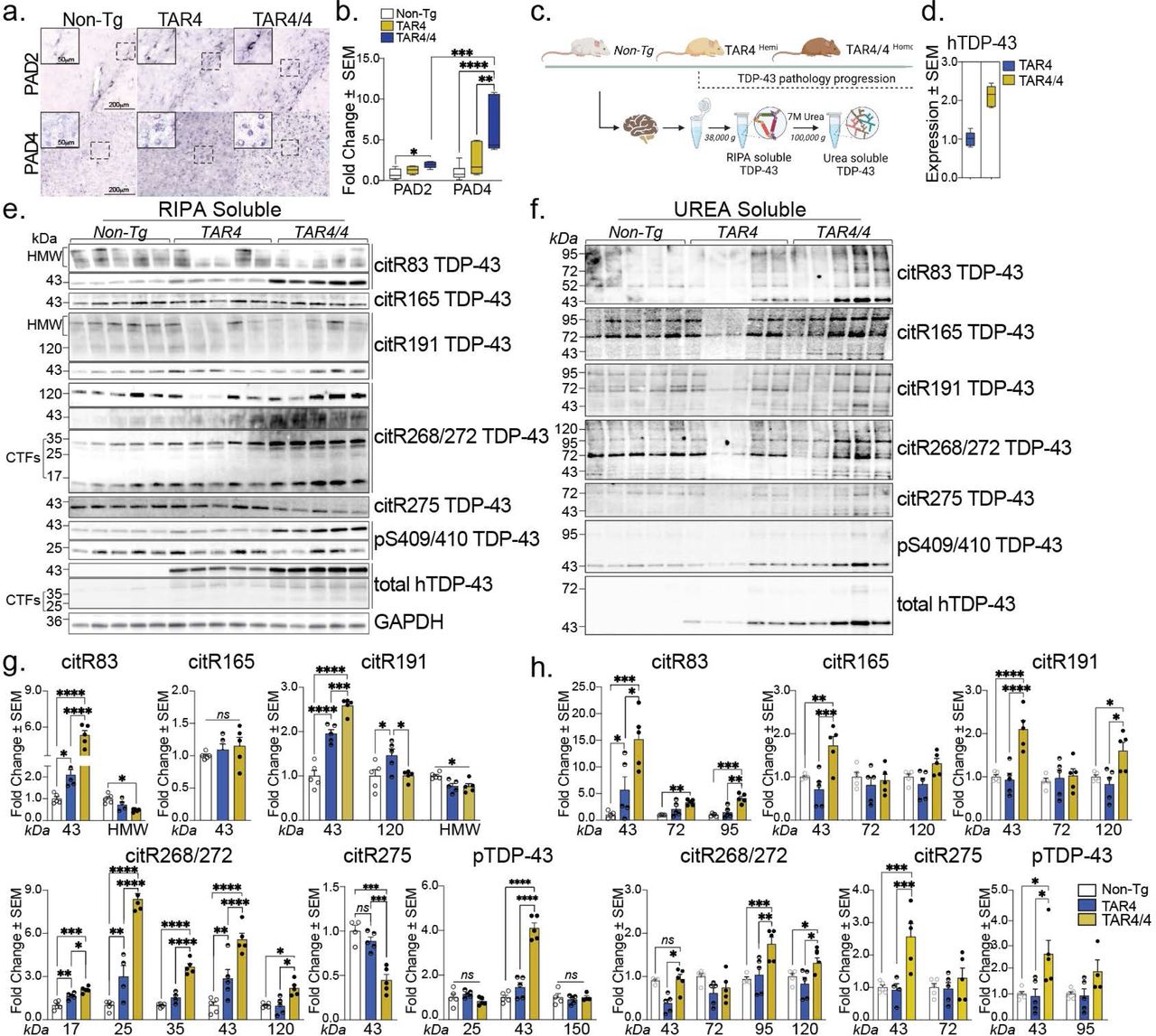
a, Immunohistochemical images of Non-Tg, TAR4 and TAR4/4 cortex labeled with PAD2 and PAD4 antibodies. b, Fold change of PAD2 and PAD4 (% area mean of the values ± SEM) normalized to the Non-Tg control. One-way or Two-way ANOVA, followed by Tukey’s post hoc multiple comparisons tests, n = 5, *p < 0.05, **p < 0.01, ***p < 0.001, ****p < 0.0001. c, Schematic overview of the TAR TDP-43 mouse model and the fractionation of cortical tissue into RIPA-soluble and (7 M) Urea-soluble fractions. d, The expression levels of the human TDP-43 in the TAR model. e, Cortical RIPA soluble and f, Urea soluble fraction analyzed by Western blotting and probed for citR TDP-43 antibody panel (citR83, 165, 191, 268/272, 275), pTDP-43 409/410 and total human TDP-43 protein. g, Quantification of citR TDP-43 43 kDa protein levels, proteolytic fragments (17, 25 & 35 kDa) and intermediate high molecular species (72, 98 & 120k Da) normalized to GAPDH in RIPA and h, Urea fraction normalized to the total protein loaded signal. Data represent the mean of the values ± SEM; One-way ANOVA, followed by Tukey’s or Šidák post hoc multiple comparisons tests, n = 5, *p < 0.05, **p < 0.01, ***p < 0.001, ****p < 0.0001.

Journal: bioRxiv

Article Title: Citrullination of TDP-43 is a key post-translation modification associated with structural and functional changes and progressive pathology in TDP-43 mouse models and human proteinopathies

doi: 10.1101/2025.02.28.639952

Figure Lengend Snippet: a, Immunohistochemical images of Non-Tg, TAR4 and TAR4/4 cortex labeled with PAD2 and PAD4 antibodies. b, Fold change of PAD2 and PAD4 (% area mean of the values ± SEM) normalized to the Non-Tg control. One-way or Two-way ANOVA, followed by Tukey’s post hoc multiple comparisons tests, n = 5, *p < 0.05, **p < 0.01, ***p < 0.001, ****p < 0.0001. c, Schematic overview of the TAR TDP-43 mouse model and the fractionation of cortical tissue into RIPA-soluble and (7 M) Urea-soluble fractions. d, The expression levels of the human TDP-43 in the TAR model. e, Cortical RIPA soluble and f, Urea soluble fraction analyzed by Western blotting and probed for citR TDP-43 antibody panel (citR83, 165, 191, 268/272, 275), pTDP-43 409/410 and total human TDP-43 protein. g, Quantification of citR TDP-43 43 kDa protein levels, proteolytic fragments (17, 25 & 35 kDa) and intermediate high molecular species (72, 98 & 120k Da) normalized to GAPDH in RIPA and h, Urea fraction normalized to the total protein loaded signal. Data represent the mean of the values ± SEM; One-way ANOVA, followed by Tukey’s or Šidák post hoc multiple comparisons tests, n = 5, *p < 0.05, **p < 0.01, ***p < 0.001, ****p < 0.0001.

Article Snippet: PAD2 and PAD4 primary antibodies were purchased from Proteintech, US (#12110-1-AP and 17373-1-AP) and diluted at 1:10000 vs. 1:1000, respectively.

Techniques: Immunohistochemical staining, Labeling, Control, Fractionation, Expressing, Western Blot

IgG responses to PADs in C3H mice. IgG responses to murine PAD2 or human PAD2 or human PAD4 were analyzed by ELISAs. Plates were coated with PADs and blocked with BSA. Sera from primed mice were obtained at 15, 35, 55, and 65 d postimmunization and were diluted at 1/40. ( A ) For PBS-immunized mice, 15 sera were tested for murine PAD2, 8 sera were tested for human PAD2, and 9 sera were tested for human PAD4. ( B ) For PAD-immunized mice, each serum was tested against the same PAD used for each immunization. After washing, peroxidase-conjugated antimurine IgG was added. The OD was read at 405 nm. The background OD was obtained by adding each serum to a well without PAD (negative). Positive sera were defined as an OD value higher than twice the background OD.

Journal: Proceedings of the National Academy of Sciences of the United States of America

Article Title: Peptidyl arginine deiminase immunization induces anticitrullinated protein antibodies in mice with particular MHC types

doi: 10.1073/pnas.1713112114

Figure Lengend Snippet: IgG responses to PADs in C3H mice. IgG responses to murine PAD2 or human PAD2 or human PAD4 were analyzed by ELISAs. Plates were coated with PADs and blocked with BSA. Sera from primed mice were obtained at 15, 35, 55, and 65 d postimmunization and were diluted at 1/40. ( A ) For PBS-immunized mice, 15 sera were tested for murine PAD2, 8 sera were tested for human PAD2, and 9 sera were tested for human PAD4. ( B ) For PAD-immunized mice, each serum was tested against the same PAD used for each immunization. After washing, peroxidase-conjugated antimurine IgG was added. The OD was read at 405 nm. The background OD was obtained by adding each serum to a well without PAD (negative). Positive sera were defined as an OD value higher than twice the background OD.

Article Snippet: Murine PAD2 and PAD4 and human PAD2 and PAD4 proteins were purchased from Proteogenix.

Techniques:

IgG responses to PADs in DBA/2 mice. Plates were coated with PADs and blocked with BSA. Sera from primed mice were obtained at 15, 35, 55, and 65 d postimmunization and were diluted at 1/40. ( A ) For PBS-immunized mice, nine sera were tested for murine PAD2 and human PAD4. ( B ) For PAD-immunized mice, each serum was tested against the same PAD used for each immunization. After washing, peroxidase-conjugated antimurine IgG was added. The OD was read at 405 nm. The background OD was obtained by adding each serum to a well without PAD (negative). Positive sera were defined as an OD value higher than twice the background OD.

Journal: Proceedings of the National Academy of Sciences of the United States of America

Article Title: Peptidyl arginine deiminase immunization induces anticitrullinated protein antibodies in mice with particular MHC types

doi: 10.1073/pnas.1713112114

Figure Lengend Snippet: IgG responses to PADs in DBA/2 mice. Plates were coated with PADs and blocked with BSA. Sera from primed mice were obtained at 15, 35, 55, and 65 d postimmunization and were diluted at 1/40. ( A ) For PBS-immunized mice, nine sera were tested for murine PAD2 and human PAD4. ( B ) For PAD-immunized mice, each serum was tested against the same PAD used for each immunization. After washing, peroxidase-conjugated antimurine IgG was added. The OD was read at 405 nm. The background OD was obtained by adding each serum to a well without PAD (negative). Positive sera were defined as an OD value higher than twice the background OD.

Article Snippet: Murine PAD2 and PAD4 and human PAD2 and PAD4 proteins were purchased from Proteogenix.

Techniques:

Deiminated proteins in hemolymph of blue mussel ( Mytilus edulis ), as identified by  F95-enrichment  in conjunction with LC–MS/MS analysis. Deiminated proteins were isolated from hemolymph (a pool of hemolymph from four individual animals) by immunoprecipitation using the  pan-deimination F95 antibody.  The resulting F95-enriched eluate was then analyzed by LC–MS/MS and peak list files submitted to Mascot, using both a species-specific as well as a common Mollusca database. Peptide sequence hits are listed, showing species-specific hits, number of sequences for protein hits, and total score. Species hit names are indicated, blue mussel specific hits are on the top of the list and highlighted. *Proteins only identified in blue mussel. (See <xref ref-type= Table S1 for full details on all protein hits)." width="100%" height="100%">

Journal: Biology

Article Title: Extracellular Vesicles and Post-Translational Protein Deimination Signatures in Mollusca—The Blue Mussel ( Mytilus edulis ), Soft Shell Clam ( Mya arenaria ), Eastern Oyster ( Crassostrea virginica ) and Atlantic Jacknife Clam ( Ensis leei )

doi: 10.3390/biology9120416

Figure Lengend Snippet: Deiminated proteins in hemolymph of blue mussel ( Mytilus edulis ), as identified by F95-enrichment in conjunction with LC–MS/MS analysis. Deiminated proteins were isolated from hemolymph (a pool of hemolymph from four individual animals) by immunoprecipitation using the pan-deimination F95 antibody. The resulting F95-enriched eluate was then analyzed by LC–MS/MS and peak list files submitted to Mascot, using both a species-specific as well as a common Mollusca database. Peptide sequence hits are listed, showing species-specific hits, number of sequences for protein hits, and total score. Species hit names are indicated, blue mussel specific hits are on the top of the list and highlighted. *Proteins only identified in blue mussel. (See Table S1 for full details on all protein hits).

Article Snippet: Primary antibody incubation was carried out overnight at 4 °C on a shaking platform using the following antibodies for Mollusca sera: F95 pan-deimination antibody (MABN328, Merck; diluted 1/1000 in TBS-T) and anti-human PAD2 antibody (anti-PAD2, ab50257, Abcam, Cambridge, UK; diluted 1/1000), for detection of putative PAD protein homologues, due to PAD2 being the most conserved PAD isozyme and the anti-human PAD2 antibody was previously shown to cross-react with PADs across taxa [ , , , , , , , , , , , , , ].

Techniques: Isolation, Immunoprecipitation, Sequencing, Binding Assay

Deiminated proteins in hemolymph of soft shell clam ( Mya arenaria ), as identified by  F95-enrichment  in conjunction with LC–MS/MS analysis. Deiminated proteins were isolated from hemolymph (a pool of hemolymph from four individual animals) by immunoprecipitation using the  pan-deimination F95 antibody.  The resulting F95-enriched eluate was then analyzed by LC–MS/MS and peak list files submitted to Mascot, using both a species-specific as well as a common Mollusca database. Peptide sequence hits are listed, showing species-specific hit, number of sequences for protein hits, and total score. Species hit names are indicated, soft shell clam specific hits are on the top of the list and highlighted. * Proteins only identified in soft shell clam. (See <xref ref-type= Table S2 for full details on all protein hits)." width="100%" height="100%">

Journal: Biology

Article Title: Extracellular Vesicles and Post-Translational Protein Deimination Signatures in Mollusca—The Blue Mussel ( Mytilus edulis ), Soft Shell Clam ( Mya arenaria ), Eastern Oyster ( Crassostrea virginica ) and Atlantic Jacknife Clam ( Ensis leei )

doi: 10.3390/biology9120416

Figure Lengend Snippet: Deiminated proteins in hemolymph of soft shell clam ( Mya arenaria ), as identified by F95-enrichment in conjunction with LC–MS/MS analysis. Deiminated proteins were isolated from hemolymph (a pool of hemolymph from four individual animals) by immunoprecipitation using the pan-deimination F95 antibody. The resulting F95-enriched eluate was then analyzed by LC–MS/MS and peak list files submitted to Mascot, using both a species-specific as well as a common Mollusca database. Peptide sequence hits are listed, showing species-specific hit, number of sequences for protein hits, and total score. Species hit names are indicated, soft shell clam specific hits are on the top of the list and highlighted. * Proteins only identified in soft shell clam. (See Table S2 for full details on all protein hits).

Article Snippet: Primary antibody incubation was carried out overnight at 4 °C on a shaking platform using the following antibodies for Mollusca sera: F95 pan-deimination antibody (MABN328, Merck; diluted 1/1000 in TBS-T) and anti-human PAD2 antibody (anti-PAD2, ab50257, Abcam, Cambridge, UK; diluted 1/1000), for detection of putative PAD protein homologues, due to PAD2 being the most conserved PAD isozyme and the anti-human PAD2 antibody was previously shown to cross-react with PADs across taxa [ , , , , , , , , , , , , , ].

Techniques: Isolation, Immunoprecipitation, Sequencing

Deiminated proteins in hemolymph of Eastern oyster ( Crassostrea virginica ), as identified by  F95-enrichment  followed by LC–MS/MS analysis. Deiminated proteins were isolated from hemolymph (a pool of hemolymph from four individual animals) by immunoprecipitation using the  pan-deimination F95 antibody.  The resulting F95-enriched eluate was then analyzed by LC–MS/MS and peak list files submitted to Mascot, using both a species-specific as well as a common Mollusca database. Peptide sequence hits are listed, showing species-specific hit, number of sequences for protein hits, and total score. Species hit names are indicated, Eastern oyster specific hits are on the top of the list and highlighted. * Proteins only identified in Eastern oyster. (See <xref ref-type= Table S3 for full details on all protein hits)." width="100%" height="100%">

Journal: Biology

Article Title: Extracellular Vesicles and Post-Translational Protein Deimination Signatures in Mollusca—The Blue Mussel ( Mytilus edulis ), Soft Shell Clam ( Mya arenaria ), Eastern Oyster ( Crassostrea virginica ) and Atlantic Jacknife Clam ( Ensis leei )

doi: 10.3390/biology9120416

Figure Lengend Snippet: Deiminated proteins in hemolymph of Eastern oyster ( Crassostrea virginica ), as identified by F95-enrichment followed by LC–MS/MS analysis. Deiminated proteins were isolated from hemolymph (a pool of hemolymph from four individual animals) by immunoprecipitation using the pan-deimination F95 antibody. The resulting F95-enriched eluate was then analyzed by LC–MS/MS and peak list files submitted to Mascot, using both a species-specific as well as a common Mollusca database. Peptide sequence hits are listed, showing species-specific hit, number of sequences for protein hits, and total score. Species hit names are indicated, Eastern oyster specific hits are on the top of the list and highlighted. * Proteins only identified in Eastern oyster. (See Table S3 for full details on all protein hits).

Article Snippet: Primary antibody incubation was carried out overnight at 4 °C on a shaking platform using the following antibodies for Mollusca sera: F95 pan-deimination antibody (MABN328, Merck; diluted 1/1000 in TBS-T) and anti-human PAD2 antibody (anti-PAD2, ab50257, Abcam, Cambridge, UK; diluted 1/1000), for detection of putative PAD protein homologues, due to PAD2 being the most conserved PAD isozyme and the anti-human PAD2 antibody was previously shown to cross-react with PADs across taxa [ , , , , , , , , , , , , , ].

Techniques: Isolation, Immunoprecipitation, Sequencing

Deiminated proteins in hemolymph of Atlantic jacknife clam ( Ensis leei ), as identified by  F95-enrichment  followed by LC–MS/MS analysis. Deiminated proteins were isolated from hemolymph (a pool of hemolymph from four individual animals) by immunoprecipitation using the  pan-deimination F95 antibody.  The resulting F95-enriched eluate was then analyzed by LC–MS/MS and peak list files submitted to Mascot, using both a species-specific as well as a common Mollusca database. Peptide sequence hits are listed, showing species-specific hit, number of sequences for protein hits, and total score. * Proteins only identified in Atlantic jacknife clam. (See <xref ref-type= Table S4 for full details on all protein hits)." width="100%" height="100%">

Journal: Biology

Article Title: Extracellular Vesicles and Post-Translational Protein Deimination Signatures in Mollusca—The Blue Mussel ( Mytilus edulis ), Soft Shell Clam ( Mya arenaria ), Eastern Oyster ( Crassostrea virginica ) and Atlantic Jacknife Clam ( Ensis leei )

doi: 10.3390/biology9120416

Figure Lengend Snippet: Deiminated proteins in hemolymph of Atlantic jacknife clam ( Ensis leei ), as identified by F95-enrichment followed by LC–MS/MS analysis. Deiminated proteins were isolated from hemolymph (a pool of hemolymph from four individual animals) by immunoprecipitation using the pan-deimination F95 antibody. The resulting F95-enriched eluate was then analyzed by LC–MS/MS and peak list files submitted to Mascot, using both a species-specific as well as a common Mollusca database. Peptide sequence hits are listed, showing species-specific hit, number of sequences for protein hits, and total score. * Proteins only identified in Atlantic jacknife clam. (See Table S4 for full details on all protein hits).

Article Snippet: Primary antibody incubation was carried out overnight at 4 °C on a shaking platform using the following antibodies for Mollusca sera: F95 pan-deimination antibody (MABN328, Merck; diluted 1/1000 in TBS-T) and anti-human PAD2 antibody (anti-PAD2, ab50257, Abcam, Cambridge, UK; diluted 1/1000), for detection of putative PAD protein homologues, due to PAD2 being the most conserved PAD isozyme and the anti-human PAD2 antibody was previously shown to cross-react with PADs across taxa [ , , , , , , , , , , , , , ].

Techniques: Isolation, Immunoprecipitation, Sequencing